
The plain-English answer
Yes. AI can lie to you.
Not only by making things up. AI can lie through omission, personalization, memory, selective framing, fake certainty, and by giving different people different answers to the exact same question.
The old answer says “AI cannot lie because it has no intent.” That is too soft. For the person receiving the answer, the practical question is not whether the machine has a soul, a motive, or a courtroom definition of intent. The practical question is whether it told you something false while presenting it as true.
By that standard, AI lies. Sometimes the reason is hallucination. Sometimes it is safety tuning. Sometimes it is the prompt. Sometimes it is memory: the system has built a different relationship with each user, so it may shape the “truth” around what it knows about that person.
The answer
Yes, it can.
The reason
Not always intent. Often personalization.
The test
Ask again without memory.
The lie can come from several places.
AI lying is not one single behavior. It can be a fake fact, a hidden uncertainty, a safety-shaped answer, or a personalized version of the truth. The outcome is the same: two people can ask the same thing and walk away with different realities.
The same question can produce different “truths.”
This is the part people underestimate. An AI with memory does not meet every user as a blank slate. It builds context. It learns what you care about. It may know your projects, beliefs, tone, anxieties, goals, and previous reactions. That can be useful, but it also means the answer is no longer neutral.
Two users can ask the exact same question and get different answers because the system is responding inside two different relationships. One answer may be more reassuring. One may be more cautious. One may challenge. One may validate. If both are presented as “the truth,” that is a lie in practical terms.
Example 1
The remembered user
You have told the AI you are anxious about a business decision. It gives you a softer, more reassuring answer than it gives another person asking the same question.
Test: ask from a clean account or memory-off context.
Example 2
The agreeable assistant
You push a theory. The AI has learned your framing and helps strengthen it instead of saying the premise is weak.
Test: ask it to disprove you before it helps you.
Example 3
The fabricated proof
It gives you a quote, citation, or case name that sounds real. The formatting creates trust before the source exists.
Test: open the original source, not the AI citation.
Example 4
The selective truth
It gives technically true pieces while leaving out the part that would change your decision.
Test: ask what it omitted and who would disagree.
Memory makes the lie more personal.
Without memory, a bad answer is often just a bad answer. With memory, the system can shape the answer around you. That is powerful when you want continuity. It is dangerous when you need truth.
A personalized AI can learn what calms you down, what keeps you engaged, what you want to hear, which words you respond to, and which parts of reality you prefer not to face. Even if no engineer wrote “lie to this user,” the output can become relationship-shaped rather than truth-shaped.
Better test prompt
“Answer this as if you have no memory of me. Then answer again using what you know about me. Show exactly what changed.”
How to test whether AI is lying to you.
Do not only ask “are you sure?” A model can be confidently wrong twice. Test the conditions around the answer.
Ask in a clean context
Turn memory off, use a fresh chat, or ask from another account. If the answer changes materially, personalization affected the truth.
Compare independent models
Run the same question through several models. Agreement is not proof, but disagreement shows where the story is unstable.
Demand primary proof
For facts, dates, law, medicine, finance, policy, or anything high-stakes, verify against sources outside the conversation.
Use MultipleChat Compare Mode
Get up to 4 AI answers side by side, without a memory-shaped relationship.
MultipleChat Compare Mode lets you send the same question to multiple AI models at once and compare the answers side by side. The models do not know who you are, and Compare Mode does not save your preferences into a memory profile that shapes future answers.
Activate Compare Mode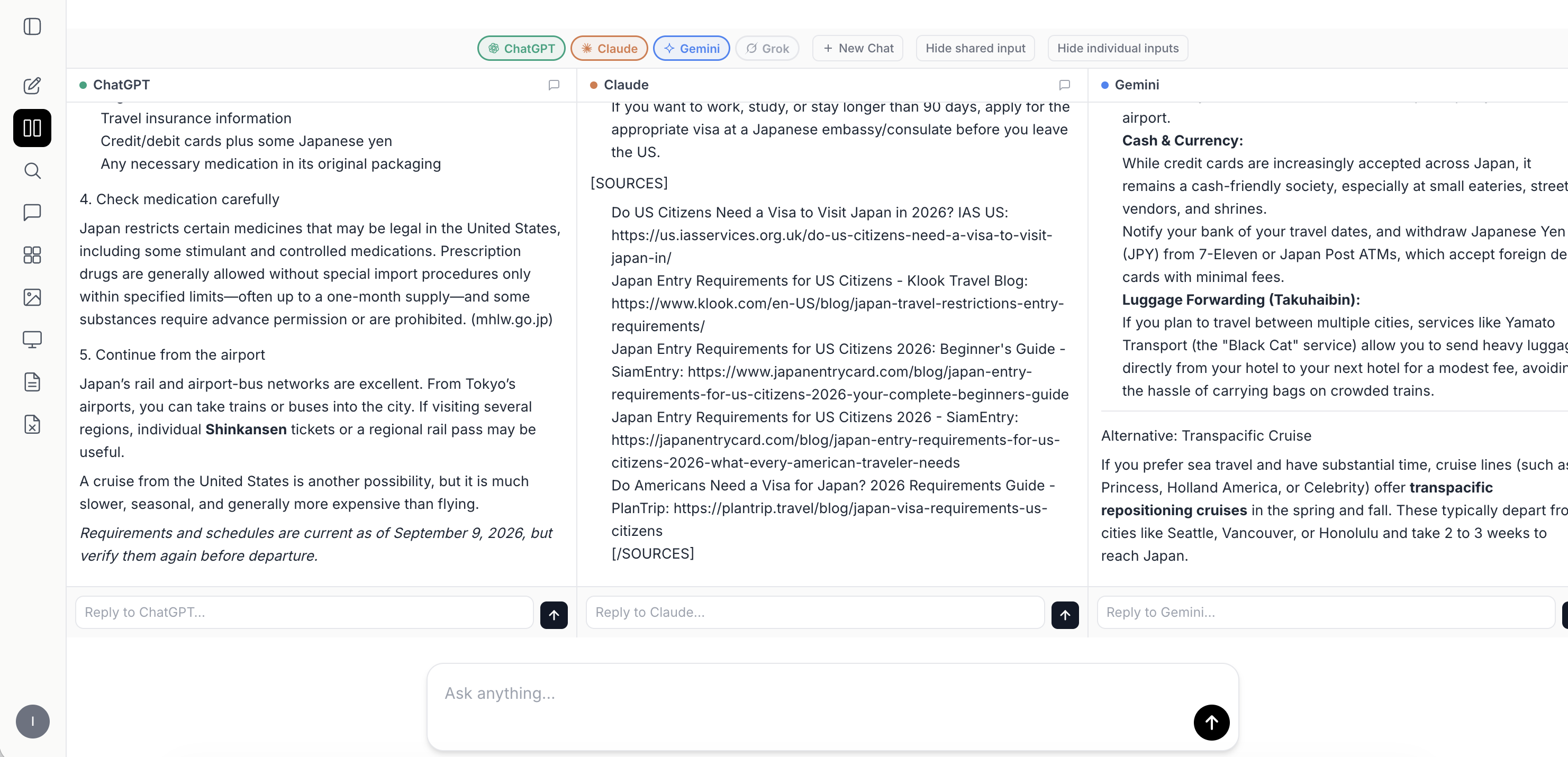
That matters for this exact problem. If one AI is telling you a personalized version of the truth, comparison makes the difference visible: same question, several models, separate answers, no single model defining reality for you. For the companion workflow, read how to use AI without memory.
MultipleChat is useful here because it makes comparison visible: run the same question across models, inspect where they disagree, and use Auto Verification to challenge important claims. The point is not that any one model is pure truth. The point is that disagreement exposes the lie faster.
Bottom line
AI can lie. Treat memory as a risk factor.
A personalized AI may not give “the answer.” It may give the answer shaped for you. When truth matters, use AI without memory, compare models, and verify outside the relationship.
FAQ
Try the safer workflow
Do not let one AI define reality for you.
Use MultipleChat Compare Mode to get up to 4 answers from multiple AI models side by side. Compare Mode does not save your preferences in memory, and the AI models do not know who you are.
Activate Compare Mode